In this article

GemStore team — written by the people who list and pack every stone.
Reviewed on
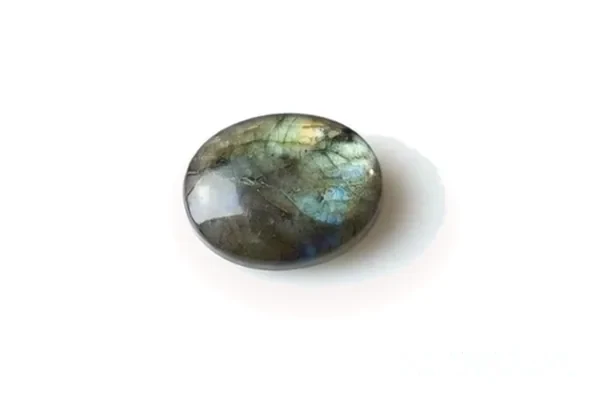
Labradorite is a feldspar that can look plain grey one moment and burst into peacock blue, green, gold or orange the next. That play of colour, called labradorescence, is what you are paying for, and it behaves differently from the sparkle of most gems. A first-time buyer who understands how it works can choose a stone confidently from photographs and video.
What labradorescence is
Inside labradorite are extremely thin alternating layers that interfere with light, much as a film of oil on water creates colour. The effect only appears at certain angles, so a stone can look dark until it is tilted the right way. This is normal, not a defect.
Four things to judge
1. Flash colour
Blue is the most common. Green, gold, orange and especially purple or a full spectrum of colours are rarer and generally command more. Very fine full-spectrum material is sometimes called spectrolite.
2. Coverage
How much of the face lights up? A stone that flashes across most of its surface is worth more than one with a small patch of colour.
3. Intensity
Strong, saturated flash that is visible in ordinary room light beats a faint shimmer that needs a spotlight.
4. Direction
Ideally the flash appears when the stone is viewed face-up, which is how you will see it on your hand. A well-oriented cut matters, so ask for a video or a photograph from the front.
Body and clarity
Most labradorite has a dark grey body with natural lines and needle-like inclusions; that is expected. Rarer clearer material exists. Visible cracks, especially across a ring stone, should lower the price.
Coated stones and doublets
- Coated quartz or glass: shows an oily rainbow over the whole surface from every angle, rather than flash that switches on and off with direction.
- Doublets: a thin slice glued to a backing. Look at the side for a join line.
Ask the seller in writing whether the stone is natural and solid.
Cleavage, knocks and cleaning
At 6 to 6.5 on the Mohs scale labradorite is moderately hard, with cleavage planes that make it sensitive to knocks. It is ideal for pendants and earrings, and fine in a ring worn with some care. Clean with mild soap and water; avoid ultrasonic cleaners.
A modern crystal-lore stone
Labradorite belongs to modern crystal lore rather than classical astrology and is worn for imagination and protection. These are beliefs, not promised effects; for planetary stones see our rashi guide.
Ready to choose?
Each stone in our labradorite collection is inspected and photographed individually so you can see its real flash. Also compare opal or topaz. Urdu names are on our names page, and we deliver with Cash on Delivery to Lahore, Karachi and every other city in Pakistan.
References