
In this article

GemStore team — written by the people who list and pack every stone.
Reviewed on
Traditional belief vs gemmology: anything on this page about luck, protection, planets, healing or religious tradition describes traditional and cultural beliefs — not proven effects, religious rulings or medical advice. A stone's identity, hardness, treatment and origin are gemmology, which a lab can test; the references at the end of the page cover that side.
Tanzanite is a young gem by any standard. It was only found in the 1960s, in one small area near Mount Kilimanjaro in Tanzania, and it is still mined nowhere else. Because it is so new, it has no place in the classical texts, and its meanings come from modern crystal lore. Here is what that tradition says, what makes the stone special, and how to wear it safely.
What tradition says
In modern crystal lore tanzanite is worn for clear thinking and calm. Some astrologers in South Asia use it as an alternative for blue sapphire, while others do not recognise it at all. These are beliefs rather than guaranteed effects, and we do not promise results. If astrology is your reason for buying, agree the stone, weight, metal and finger with your astrologer before a ring is made. Our rashi guide shows the common pairings.
One stone, three colours
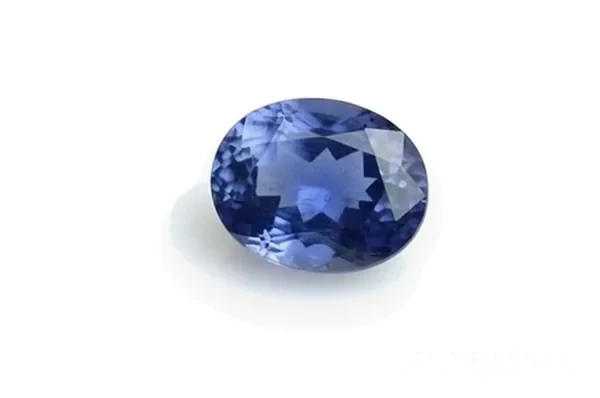
Tanzanite is strongly pleochroic: viewed from different directions it shows blue, violet and a burgundy or bronze tone. The cutter decides which colour faces up. Most stones are oriented to show a blend of blue and violet, and that balance is a large part of their value. Turn a stone slowly in your fingers and you should see the shift.
Heat treatment is normal
Almost all tanzanite comes out of the ground with a brownish component and is gently heated to bring out the blue-violet. This is standard, stable and expected. Coated stones are a different matter: a thin surface coating can wear off, so ask the seller whether the stone has been coated.
Telling it from iolite and glass
Iolite also changes colour with angle, but usually from violet-blue to a pale grey or yellowish tone, without tanzanite's burgundy flash. Blue glass shows one colour from every angle and often has round bubbles. A flawless, vivid and cheap stone deserves caution.
Wearing it with care
At 6 to 7 on the Mohs scale, with one direction of perfect cleavage, tanzanite is better suited to pendants and earrings, or a ring with a protective setting that is removed for hard work. Avoid ultrasonic and steam cleaners and sudden temperature changes; clean with mild soap and water.
What affects the price
Depth and saturation of colour are the main drivers, followed by clarity, cut and size. We price each stone individually.
Before you buy
Check that the stone is natural, any treatment is in writing and the weight is the cut stone's. We inspect every stone and photograph each one alone. Browse tanzanite, or compare yellow sapphire and emerald. Urdu and English names are on our gem names page, and Cash on Delivery reaches Lahore, Karachi and every other city.
References











