
In this article

GemStore team — written by the people who list and pack every stone.
Reviewed on
Traditional belief vs gemmology: anything on this page about luck, protection, planets, healing or religious tradition describes traditional and cultural beliefs — not proven effects, religious rulings or medical advice. A stone's identity, hardness, treatment and origin are gemmology, which a lab can test; the references at the end of the page cover that side.
Short answer: the modern birthstone list gives each calendar month one or more gemstones – garnet for January through to turquoise, tanzanite and zircon for December. It was standardised by American jewellers in 1912 and has been updated a few times since. In Pakistan many people also follow the Vedic rashi system, which picks a stone by moon sign and ruling planet rather than by month. The two lists overlap but are not the same, so choose the month stone for meaning and gifting, and the rashi stone if your interest is astrological.
If you only need a quick reference table, our find your birthstone page has one. This guide goes further: where the custom came from, what each stone is and what it has traditionally symbolised, practical buying notes for each month, and how the Western list lines up with rashi stones.
How the birthstone tradition developed
- The breastplate of Aaron. The Book of Exodus describes twelve stones set in the high priest's breastplate, one for each tribe of Israel. This is usually cited as the starting point.
- Early interpretations. Writers in the first centuries AD connected those twelve stones with the twelve months and the signs of the zodiac. For a long time the custom was to own a set and wear each stone in its month.
- Wearing one stone. By around the eighteenth century, the custom of wearing only the stone of one's birth month had become popular in parts of Europe, with Poland often mentioned.
- The 1912 list. The American National Association of Jewelers published a standard list in 1912. Later additions included alexandrite for June (1952), tanzanite for December (2002) and spinel for August (2016).
Separately, and much older in the subcontinent, Jyotish astrology developed the navaratna: nine gems for nine planetary influences. Here the stone is chosen from the birth chart, not the calendar. We cover that system in detail in gemstones by rashi.
The twelve months, season by season
January – Garnet
Garnet is a group of related minerals; the classic January reds are almandine and pyrope, while rhodolite gives raspberry tones. Garnet has been worn for thousands of years, from ancient Egypt to Mughal jewellery, and travellers once carried it as a protective charm. Traditional meaning: protection, energy and loyalty. Buying note: look for a bright, transparent red that is not too dark; garnet is rarely treated, which makes it a straightforward buy. Browse garnet or read the January birthstone guide.
February – Amethyst (jamunia)
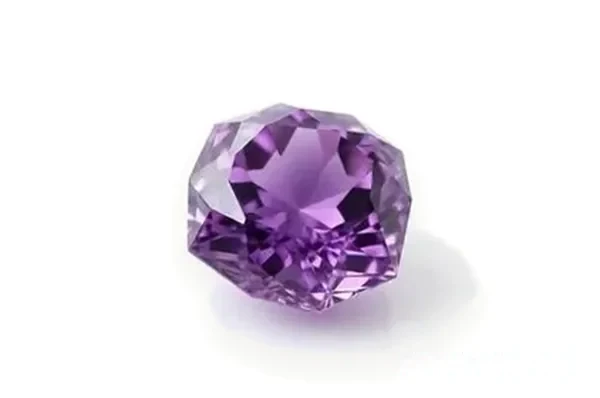
Purple quartz, long associated with bishops and royalty. The ancient Greeks linked it with sobriety, and the name is usually explained as "not intoxicated". Traditional meaning: calm, clarity and balance. Buying note: a deep, even purple with flashes of red is most prized; long exposure to strong sunlight can fade it. See amethyst and the February birthstone guide.
March – Aquamarine (beruj)
The blue variety of beryl, long associated with sailors and the sea. Northern Pakistan, especially Gilgit-Baltistan, is a well-known source of clean, attractive aquamarine crystals. Traditional meaning: courage, calm and safe travel. Buying note: pure blue without a green tint is most valued; much aquamarine is gently heated to remove green, which is accepted. See aquamarine and the March birthstone guide.
April – Diamond (heera)
The hardest natural material and a long-standing symbol of strength and lasting love. If you would like an alternative, natural white sapphire (often called safed pukhraj locally) offers hardness 9 and a bright, colourless look, and in Vedic practice it is sometimes worn as a substitute for diamond for Venus. Read about April birthstone alternatives.
May – Emerald (zamurd / panna)
Green beryl, prized in ancient Egypt and by the Mughal emperors, whose carved emeralds are still admired. Traditional meaning: renewal, wisdom and love. Buying note: inclusions are normal, so a flawless, cheap emerald is suspicious; Swat in Pakistan is known for intensely coloured small stones. Read how to identify a natural emerald, the May birthstone guide, or browse emerald.
June – Pearl (moti), moonstone and alexandrite
June has three stones. Pearl grows inside a mollusc and was among the first gems people used; moonstone is a feldspar with a soft, floating blue-white sheen; alexandrite is a rare chrysoberyl that looks green in daylight and red under incandescent light. Traditional meaning: purity, intuition and balance, with pearl and moonstone associated with the Moon. Buying note: real pearls usually feel slightly gritty when rubbed gently against a tooth; good moonstone shows a sheen that glides as you tilt it. See pearl, moonstone and the June birthstone guide.
July – Ruby (yaqoot)
Red corundum, often called the king of gems, and in Vedic tradition the stone of the Sun. Traditional meaning: passion, vitality and courage. Buying note: colour drives value, so a vivid smaller stone usually beats a larger dull one; avoid glass-filled stones sold as ruby. Read our ruby guide, the July birthstone guide, or browse ruby.
August – Peridot (zabarjad) and spinel
Peridot occurs only in shades of green, from olive to lime, and has even been found in meteorites. Some of the finest peridot of recent decades has come from the Kohistan area of northern Pakistan. Spinel, added in 2016, comes in reds, pinks and blues. Traditional meaning: well-being, good fortune and protection. Buying note: choose a lively green without brown; avoid sudden temperature changes. See peridot and the August birthstone guide.
September – Blue sapphire (neelam)
Long associated with royalty and clergy, and in Jyotish with Saturn. Traditional meaning: wisdom, loyalty and discipline. Buying note: Sri Lankan stones are a classic choice, and origin claims need a laboratory report. Read sapphire origins, neelam benefits, the September birthstone guide, or browse blue sapphire.
October – Opal and tourmaline
Opal can show flashes of every spectral colour moving across one stone. Pink tourmaline was added as a tougher alternative, and tourmaline in many colours is mined in Pakistan's northern areas. Traditional meaning: creativity and hope. Buying note: judge opal by the brightness and spread of its play-of-colour, and watch for doublets (thin slices on a backing) sold as solid stones. See opal, tourmaline and the October birthstone guide.
November – Topaz and citrine
Two golden stones linked with warmth, abundance and friendship. Topaz is harder (8) and often brighter; citrine is yellow quartz (7) and more affordable. Buying note: make sure you know which one you are buying, because citrine and yellow topaz are often sold as cheap substitutes for pukhraj, which is yellow sapphire. See topaz, citrine and the November birthstone guide.
December – Turquoise (feroza), tanzanite and zircon
Turquoise has been worn for protection across Persia, Central Asia and this region for thousands of years, and Persian (Nishapuri) feroza is the most admired. Tanzanite, found commercially only near Merelani in Tanzania, brings a violet-blue; blue zircon is the third option. Traditional meaning: protection and good fortune. Buying note: much turquoise is stabilised or dyed, so look for natural variation; tanzanite is relatively soft and suits pendants and earrings. See feroza, tanzanite and the December birthstone guide.
Month stones and rashi stones side by side
The month list is a jewellery custom; the rashi list is an astrological recommendation. Where they connect:
| Month stone | Related rashi stone in Vedic tradition |
|---|---|
| Ruby (July) | Ruby for Simha (Leo) – the Sun |
| Pearl / moonstone (June) | Pearl for Kark (Cancer) – the Moon |
| Emerald (May) | Emerald for Mithun (Gemini) and Kanya (Virgo) – Mercury |
| Blue sapphire (September) | Neelam for Makar (Capricorn) and Kumbh (Aquarius) – Saturn |
| Topaz / citrine (November) | Yellow sapphire (pukhraj) for Dhanu (Sagittarius) and Meen (Pisces) – Jupiter; citrine and topaz are traditional substitutes |
| Garnet (January) | Red coral for Mesh (Aries) and Vrishchik (Scorpio) – Mars; hessonite garnet (gomed) for Rahu |
| Diamond (April) | Diamond or white sapphire for Vrishabh (Taurus) and Tula (Libra) – Venus |
If you are choosing for astrological reasons, rely on your rashi and a qualified astrologer's reading of your chart. If you want a meaningful gift or simply love a stone's colour, the month list is a lovely guide.
Choosing and buying a birthstone well
- Choose natural. Synthetics and glass carry none of the tradition. GemStore sells natural loose stones only, and we inspect every stone – see our authenticity page.
- Match hardness to use. Garnet, sapphire, ruby, topaz and aquamarine suit everyday rings. Opal, pearl, turquoise, moonstone and tanzanite are safer in pendants and earrings.
- Ask about treatment. Heated aquamarine and sapphire are normal; glass-filled ruby and dyed turquoise should be disclosed and priced accordingly.
- Check the price per carat. Divide the price by the carat weight so you can compare stones of different sizes.
- Plan the setting. If you would like a custom silver ring, you can discuss it with us on WhatsApp.
- Know the return terms. Our 7-day return policy covers stones returned unused in their original condition and packaging.
Browse every birthstone in our shop, each one an individual stone photographed as it is. We deliver to Lahore, Karachi, Islamabad and every city in Pakistan with Cash on Delivery. Not sure which stone suits a birthday or a budget? Ask us.
References











